



“Toward Sustainable, Resilient, and High-Value Tourism: A Pathway to Private Sector–Led Job Creation and Shared Prosperity,” outlines strategic priorities for the industry’s future in Mauritius.
Total Views :
1982


“Toward Sustainable, Resilient, and High-Value Tourism: A Pathway to Private Sector–Led Job Creation and Shared Prosperity,” outlines strategic priorities for the industry’s future in Mauritius.
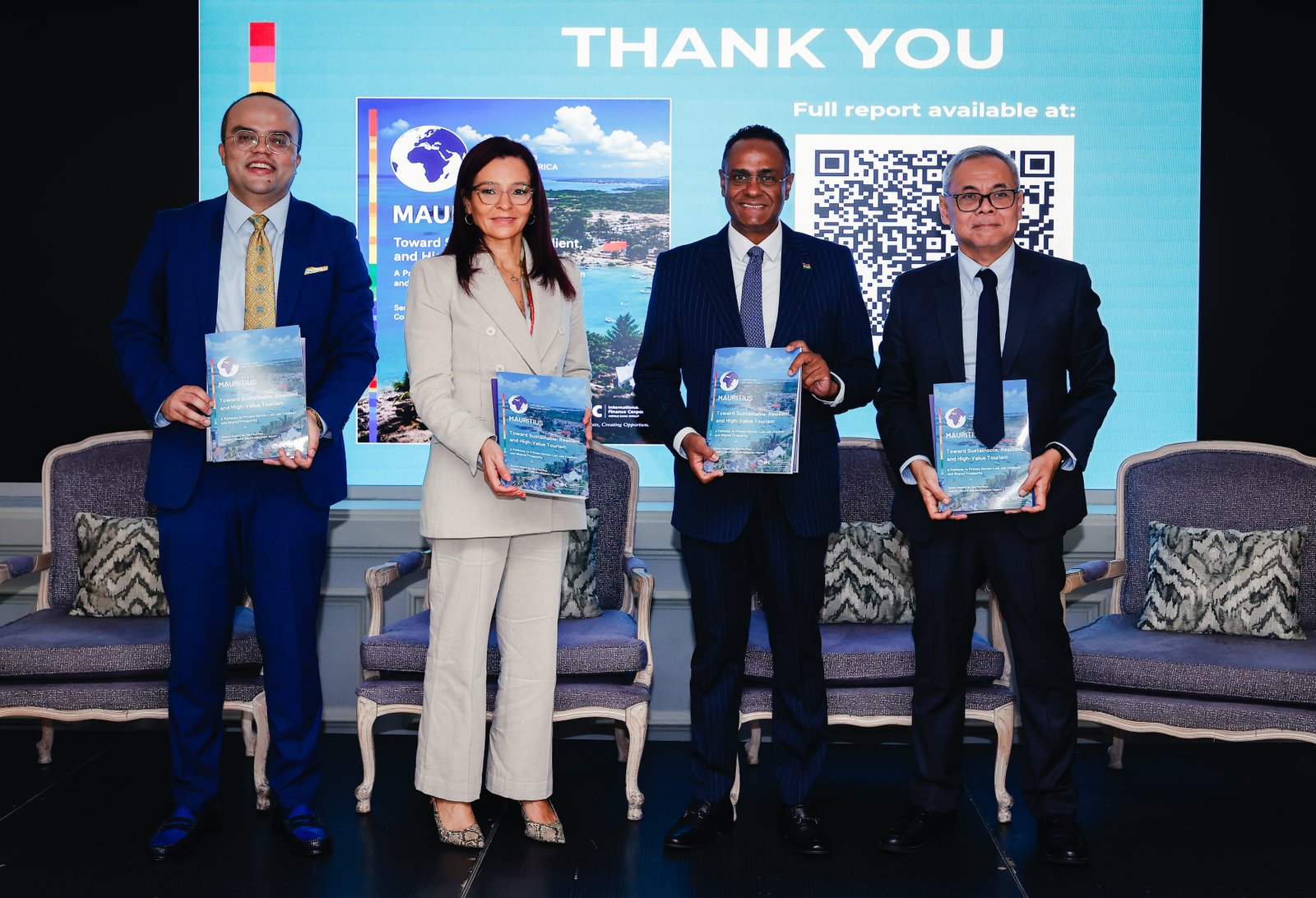
Port Louis, Mauritius, May 12, 2026 -- The International Finance Corporation (IFC) hosted the High-Level Launch of the IFC Tourism Report in Mauritius today, entitled “Toward Sustainable, Resilient, and High-Value Tourism: A Pathway to Private Sector–Led Job Creation and Shared Prosperity”, in Port Louis.
The launch event followed the World Bank Group’s Mauritius Country Climate and Development Report (CCDR), launched in Mauritius in February 2026, and brought together government leaders, tourism operators, financial institutions, investors, and development partners to discuss the report’s findings and explore how Mauritius can translate its strategic vision for sustainable, high-value tourism into concrete investments and practical solutions.
The keynote address was delivered by The Hon. Jean Sydney Pierre, Junior Minister of Tourism of Mauritius, who underlined that “sustainable tourism is not about limiting development. It is about developing smarter, better, and more responsibly. Mauritius has the potential to become a global benchmark for sustainable island tourism”.
“But achieving this vision will require courage, collaboration, and long-term commitment from all stakeholders. As we move towards our Vision 2050 aspirations, partnerships, such as those with the International Finance Corporation and the World Bank Group, will remain extremely valuable in helping us mobilize expertise, financing innovation, and international best practices”, he concluded.
The session was led by IFC’s Regional Director for Southern Africa, Cláudia Conceição who highlighted the IFC’s commitment to supporting climate-smart, private sector–driven solutions in Mauritius and to fostering deeper collaboration across the World Bank Group to help build a resilient and future-ready tourism economy.
Cláudia Conceição stated that the IFC and World Bank Group are committed to playing their part through advisory work, direct investment, and innovative instruments such as blue and green bonds, sustainability-linked finance, and blended finance structures. “Our focus is to help move from pilot initiatives to scalable, bankable investments, and to mobilize private capital into solutions that can transform the sector and enhance its resilience,” she underlined.
Mounir Bari, IFC economist concluded on the positive note that “Mauritius can lead a tourism transformation that delivers a triple win for people, planet and prosperity”.
Key Themes for Media
1. Shifting to high-value, low-volume tourism in Mauritius can create better-quality jobs and sustain tourism even under climate stress
The tourism sector remains the cornerstone of Mauritius’s economy, underpinning growth, employment, and external stability. Tourism accounts for around 20 percent of gross domestic product (GDP) and 14 percent of employment, concentrated in tourism-related industries, and is one of the country’s most powerful tools for generating foreign exchange, employment, and investment. Gross tourism earnings reached around MUR 93.6 billion in 2024, equivalent to about US$2.1 billion.
In addition, tourism serves as a platform for economic diversification, unlocking demand for domestic agriculture, fisheries, cultural goods, construction, and transport services. Its multiplier effects ripple across the entire economy, benefiting both urban and rural communities. In 2023, the travel and tourism sector accounted for 33.7 percent of Mauritius’s total greenhouse gas (GHG) emissions, with transportation being the largest contributor to the sector’s carbon footprint.
The report emphasizes that shifting to high-value, low-volume tourism—including eco-tourism, wellness, and cultural tourism—can create better-quality jobs and sustain employment even under climate stress. This will mean equipping the tourism workforce with new climate- and sustainability-related skills aligned with global sustainability standards and more stringent visitor expectations associated with higher-end tourism segments.
2. Private sector climate action is well underway – but remains uneven across measures
Climate change could cut Mauritius’ leisure tourism revenue by up to 17% by 2050, according to the findings, driven mainly by a projected decline in international tourism by 10-17% vs. 2-4% for domestic tourism. It was noted that high coastal concentration increases exposure to climate risks, with 50% of beaches projected to be lost by 2075.
In terms of private sector action to respond to climate risks, renewable energy is the most adopted measure, where 64% of operators have invested in solar or similar systems. Water management is emerging as a priority, where 36% of operators have implemented rainwater harvesting and related measures, while other measures taken so far include sandbags (36%), seawalls (24%) and coral rehabilitation (40%).
It was highlighted that high costs and a lack of incentives are the main barriers holding back private sector climate action in the tourism sector, followed by limited access to finance, regulatory processes and friction, as well as skills gaps and implementation delays.
3. Mauritius’s tourism transition creates major investment opportunities
It was highlighted that there are key investment opportunities across the tourism ecosystem, namely asset upgrading and green retrofitting; renewable energy and utilities; climate-resilient infrastructure; diversified and nature-based tourism; circular economy and green mobility; and tourism services and digital platforms.
Financing solutions in terms of green and blended finance include green bonds; sustainability-linked bonds; blended finance structures; risk sharing and guarantees, and project finance and Public-Private Partnership models.
4. Key Recommendations
- Product development: Formalize the moratorium on new beachfront hotel development to reduce pressure on coastal zones; and promote upgrading and renovations of existing properties and inland product diversification to eco, wellness, cultural, and adventure tourism, aiming to license 100 new inland/niche operators by 2030.
- Greening tourism firms: Encourage tourism firms to become climate resilient by: a) mandating increasingly stringent sustainability and climate resilience standards into building and (re)licensing requirements for tourism businesses; and (b) expanding access to green finance to support renewable energy, energy efficiency, and water saving measures across the tourism sector.
- Institutional coordination: Establish a Climate Resilient Tourism Task Force to oversee implementation of coastal and inland tourism management plans, ensure cross-sectoral coordination, and address land use conflicts and climate risks.
- Climate-resilient infrastructure: Strengthen tourism resilience through large-scale coastal rehabilitation and erosion control projects (including green and gray infrastructure) and invest in visitor infrastructure to enable market diversification beyond beach tourism.
- Destination development: Accelerate green certification of Mauritius as a sustainable destination by 2030; and pilot green destination certification in Rodrigues.
- Data and monitoring: Establish a reporting and benchmarking system for tourism sector GHG emissions, integrating measurable KPIs, compliance monitoring, geographic information systems (GIS) tools, and climate risk modelling.
- Skills development: Assess and plan for emerging skills needs to support the tourism’s sector green transition; and integrate these findings into updated certification standards, vocational training, and education curricula.
IFC’s Regional Director for Southern Africa
Cláudia Conceição is the Regional Director for Southern Africa at IFC- International Finance Corporation. She joined IFC in September 2023 and leads the organization's strategy and operations in 11 countries within the Southern Africa region. As a Director, Cláudia is responsible for increasing IFC’s impact and supporting development in the region’s agribusiness, infrastructure, and financial sectors, among others, as well as supporting green and climate response projects
About IFC:
IFC — a member of the World Bank Group — is the largest global development institution focused on the private sector in emerging markets. We work in more than 100 countries, using our capital, expertise, and influence to create markets and opportunities in developing countries. In fiscal year 2025, IFC committed a record $71.7 billion to private companies and financial institutions in developing countries, leveraging private sector solutions and mobilizing private capital to create a world free of poverty on a livable planet. For more information, visit www.ifc.org.
#InternationalFinanceCorporation(IFC) #PathwaytoPrivateSector–LedJobCreationandSharedProsperity